
How print pricing actually works
Ask for 250 booklets and then 500, and the second quote is nowhere near double the first. That surprises people, and it makes print pricing feel arbitrary. It is not. It follows from two physical facts: getting a press ready costs the same regardless of how long it runs, and paper arrives in large sheets that your finished piece has to be cut out of. Understand those two and print quotes stop being mysterious.
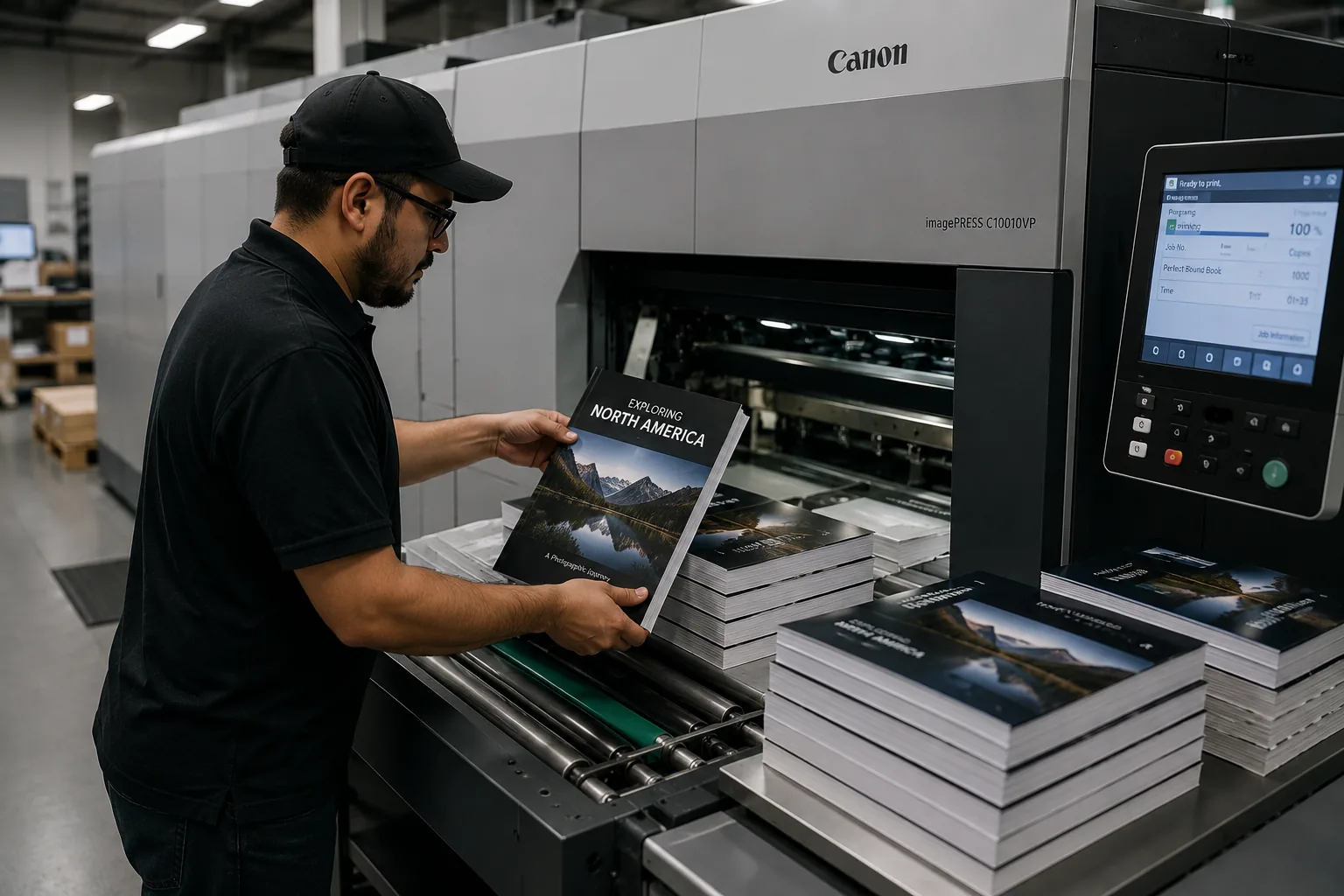
Fact one: setup does not care how long you run
Before a single good copy comes off a press, work has to happen. Files are prepped, plates or images are made, the press is brought up to color, stock is loaded, and the first sheets are pulled and checked against the proof. That effort is nearly identical whether the run is 250 pieces or 5,000.
So a short run carries the whole setup cost across very few pieces. Double the quantity and the same setup spreads twice as far. That is the entire reason the unit price falls so sharply at low quantities and then flattens out: once setup is diluted, you are mostly paying for paper, ink, and press time, which do scale with quantity.
The practical consequence: ask for pricing at several quantities before you decide. The jump from 250 to 500 is frequently small in absolute dollars and large in unit price. The jump from 5,000 to 10,000 is the opposite. Where that curve bends is worth knowing before you commit, and it differs by product.
Why we quote quantity breaks: not as a sales tactic but because the curve is real and the bend is not where most people guess. A quantity break is the printer telling you where their cost structure changes. It is genuinely information, and you should ask for it.
Fact two: your piece is cut out of a bigger sheet
Presses do not print business cards. They print large sheets, and your finished piece is one of several arranged on that sheet and cut apart afterwards. The arrangement is called imposition, and how many of your pieces fit on one sheet is called the number of "ups."
This is where quotes get counterintuitive, because the number of ups depends on geometry rather than on how big your piece feels.
Consider a piece that fits eight-up on a press sheet. You need 1,000 finished pieces, so you need 125 press sheets. Now make that piece slightly larger, such that only six fit. You need 167 sheets: a third more paper and a third more press time, for a piece that is marginally bigger. Nothing about your job changed conceptually, but the arithmetic moved a lot.
The same effect works in your favour. A small trim reduction that gets one more piece onto the sheet can lower your cost noticeably. This is the single most useful thing to ask a printer: is my size efficient on your press sheets, and would a small change improve it?
Bleed is part of this
If your design runs color to the very edge of the finished piece, it has to be printed slightly larger and trimmed down, because no cutter is perfect. That extra margin is called bleed, and it consumes sheet space. A design with a white border can sometimes fit more-up than the same design bleeding off the edge.
None of which means avoid bleed. Edge-to-edge color looks better for many pieces and is worth paying for. It means the decision has a price, and you should know it is a decision.
Where the savings come from on our side
Two levers reduce what a job costs, and they work differently. We show both on a quote as their own lines, because a saving you cannot see is a saving you cannot verify.
Bulk: aggregating your own quantity
This is the familiar one. Finished units across your order are counted together, so you reach a better price band than each piece would reach alone. If you are ordering three related items, ordering them together frequently prices better than ordering them separately across three months.
Ganging: sharing a press run with other work
This one is less familiar and more interesting. If two jobs need the same paper stock, the same printed sides, the same finish, and have the same bleed treatment, they can be arranged on the same press sheets and run together. One setup, one press run, two jobs, and the setup cost splits between them.
Our systems do this grouping automatically. Compatible jobs are identified and combined without anybody manually hunting for matches, which matters because the opportunity is easy to miss by hand and short-lived: it depends on what else happens to be running.
You never see the sheet geometry, and you should not have to. What appears on your quote is a line that says ganging pricing was applied and the amount it saved you. The system does the combinatorics; you see the dollars.
What this means for how you order: flexibility on paper stock and finish is worth money, because it widens the set of jobs yours can be combined with. If you are indifferent between two similar stocks, saying so lets us put you in the more advantageous group. Rigid specs are fine and sometimes necessary; they are just worth choosing deliberately.
The other things on a print quote
| Component | What drives it | Scales with quantity? |
|---|---|---|
| Setup and prepress | File prep, imaging, bringing the press to color | No |
| Paper | Sheets required, which depends on ups and page count | Yes |
| Press time | Impressions run, sides printed, color versus black and white | Yes |
| Cutting and trimming | Number of cuts, how many lifts of stock, knife changes | Partly |
| Binding | Method: saddle stitch, perfect bind, coil or Wire-O, case bind | Yes |
| Finishing | Folding, scoring, drilling, lamination, and specialty work | Varies |
| Proofs | Digital proof, or a physical sample mailed to you | No |
| Expedite | Whether your date is inside standard production time | No |
Two rows are worth expanding. Cutting is priced by physical work rather than by piece count: stock is cut in lifts, a lift being as much as the cutter can clamp at once, so cost moves in steps rather than smoothly. And specialty finishing behaves differently from everything else on this list, which is the subject of the next section.
The finishing that changes the rules
Most finishing happens on our own floor: folding, scoring, three-hole drilling, corner stapling, shrinkwrapping. Those are predictable and usually add no meaningful lead time.
Five operations behave differently: foil stamping, embossing, spot UV coating, die-cutting, and PMS ink matching. These run through a finishing partner, carry a 1,000-piece minimum, and are quoted by hand rather than instantly. If your project needs one of them, the honest thing to tell you is that a person will price it and that the minimum is real.
We would rather say that plainly than produce an instant number that turns out to be wrong. When our estimating system cannot price something properly, it routes the job to a person for review instead of generating a confident guess. An unpriceable line never becomes a silent placeholder.
How to get a better print price
- Ask for several quantities. The curve bends somewhere useful, and it is rarely where you would guess.
- Ask whether your trim size is efficient. A small dimensional change can add an up and cut your paper cost.
- Be flexible on stock where you genuinely do not care. It widens what your job can be combined with.
- Give real lead time. Expedite is a line item, and standard production time is seven days for most work.
- Order related pieces together. Aggregated quantity reaches better bands than three separate orders.
- Decide about bleed on purpose. It is worth paying for when it matters and free to skip when it does not.
Why we show the savings lines
A quote that shows only a total asks you to trust it. A quote that shows what bulk aggregation saved you and what ganging saved you is making a checkable claim, which is a different relationship. It also means when a number moves between quotes, you can see which lever moved.
That is a small example of a value we take seriously. We do not compete by being the lowest bid; we compete on systems that reduce waste, then pass the savings along. Ganging is waste reduction in the most literal sense: the same setup, the same sheet, less of both thrown away.
The bottom line
Print pricing is setup diluted across a run, plus paper determined by how efficiently your piece fits a press sheet, plus the finishing you choose. Nothing about it is arbitrary once you know those two facts.
Ask about quantity breaks and ask whether your size is sheet-efficient. Those two questions will do more for your print budget than negotiating a percentage.
Related reading
Choosing a binding method
Saddle stitch, perfect bound, coil, Wire-O, or case bound. What each one is actually for.
Read →What a printer needs from your file
Bleed, resolution, fonts, and trim. The file problems that delay jobs, and how to avoid them.
Read →Get a print quote with the math shown
Tell us what you are printing, how many, and when you need it. We will quote it at a few quantities so you can see where the curve bends, and flag anything about your size or stock that is working against you.
Get a print quote