
What a return actually costs you
Returns are the part of ecommerce that brands plan for last and pay for first. Around one in five online orders comes back, each one costs real money to process, and the cost is distributed across so many small line items that most brands never see the total. This is the arithmetic, and the four places it is worth intervening.
The scale of it
Industry benchmarks put the average ecommerce return rate at roughly 19% to 20% of online sales, up from around 11% in 2020. The category spread is wide: apparel runs 20% to 40%, electronics 8% to 15%, beauty 4% to 12%. Processing one return costs roughly $25 to $30 all in, counting return shipping, labor, inspection, and restocking. Deloitte’s retail operations research puts average return processing cost in a range of 24% to 71% of item value.
Sit with that last figure. For a meaningful share of returns, processing costs more than a quarter of what the item is worth, and at the top of the range it exceeds half. Returns are not a customer-service function with a cost attached. They are a manufacturing process running in reverse, with worse economics than the forward one.
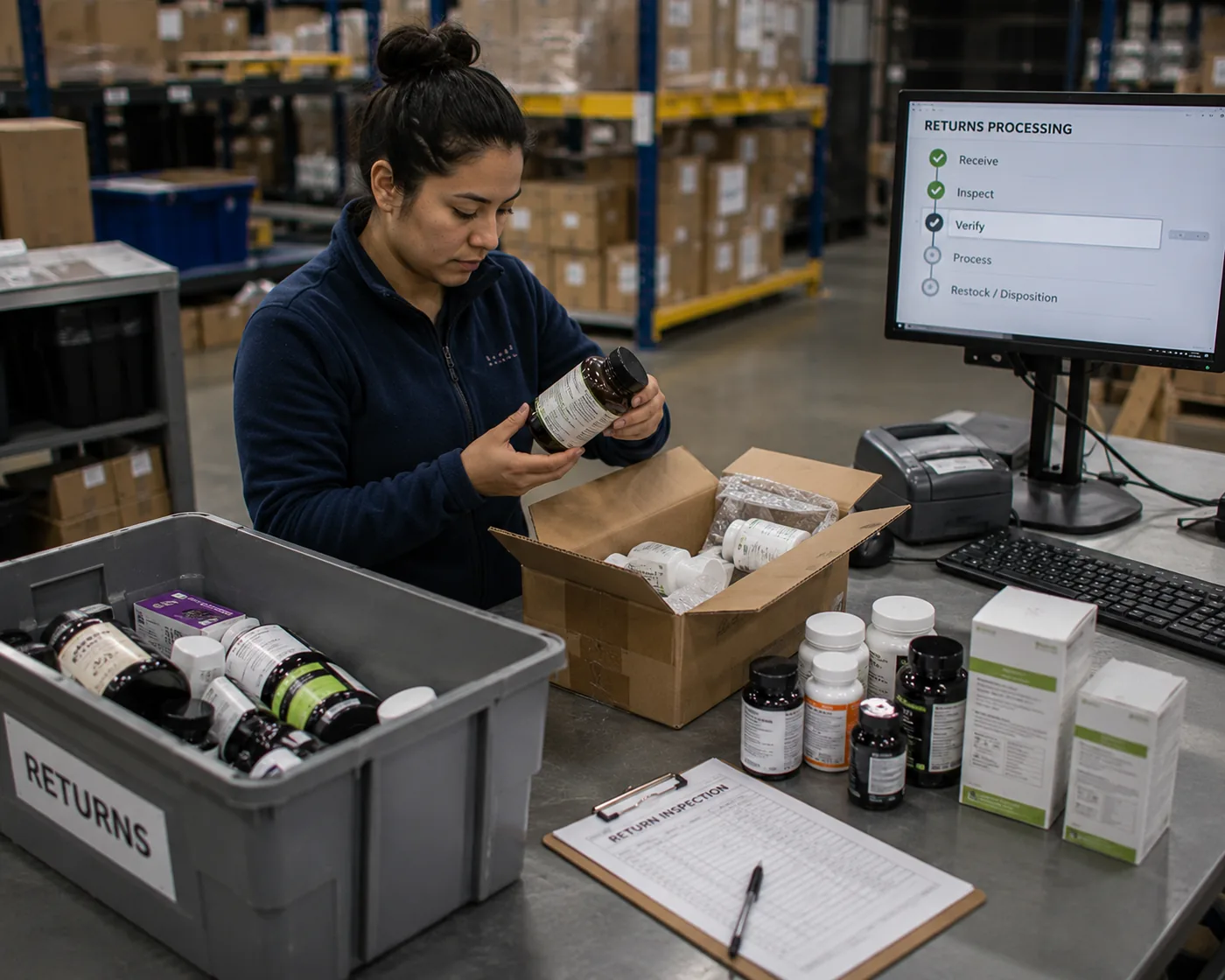
Why reverse is harder than forward: outbound is a known SKU, in known condition, in a known carton, on a planned schedule. Inbound returns are an unknown SKU in unknown condition arriving unannounced. Every efficiency that makes outbound cheap depends on predictability, and returns have none.
The full cost stack of one return
| Cost | What it covers | Recoverable? |
|---|---|---|
| Return transportation | The inbound parcel, whether you paid for the label or the customer did | Sometimes |
| Receiving and sort | Taking it in, identifying it, matching it to an order | No |
| Inspection | Assessing condition against a documented standard | No |
| Disposition | Restock, refurbish, repackage, liquidate, or dispose | Partly |
| Repackaging | New polybag, new carton, new insert if the original is unsellable | No |
| Original outbound | The pick, pack, and parcel you already spent getting it there | No |
| Value loss | The gap between original price and what it now sells for | No |
| Support time | The conversation, the label, the refund, the follow-up | No |
One row deserves emphasis because it is the one brands forget: the original outbound cost is gone. You paid to pick, pack, and ship that order. A return does not refund it. So the true cost of a return is the reverse cost plus the forward cost you already sank, which is why a $30 processing cost on a $60 item can erase the entire contribution margin and then some.
Return fraud is now a line item
The National Retail Federation estimates roughly 9% of returns are fraudulent: wardrobing, empty-box scams, counterfeit returns. Broader measures that include policy abuse put return fraud north of $100 billion a year, around 15% of all return volume. Roughly 85% of retailers now deploy some form of detection.
You cannot address this with a policy document alone, because the mechanism is evidentiary. What actually helps is documentation at the moment of receipt: what came back, in what condition, against what order, with a record. That turns a dispute into a comparison. It is the same principle as counting inventory at the dock during a transition rather than three weeks later, and for the same reason. Evidence collected at the moment costs almost nothing. Evidence reconstructed afterward does not exist.
The four places to intervene
1. Prevent the return you can
The cheapest return is the one that never happens, and a meaningful share of returns are information failures rather than product failures. Wrong size, wrong expectation, wrong colour on a monitor. Sizing detail, dimensioned photography, and specific product copy reduce returns measurably and cost nothing per order once written.
Separately, some returns are your fulfillment provider’s fault, and those are worth isolating in your data. If a return reason code is “wrong item received,” that is not a customer preference problem. Barcode-verified picking exists precisely to keep that number small: the scan checks the SKU against the order before it leaves the aisle, and a verified Argo pick or pack error earns a service credit against your Argo fees. Terms apply.
2. Get the parcel back cheaply
Return transportation responds to the same levers as outbound: service level, zone, and packaging. A return does not need a premium service, because nobody is waiting for it. Consolidated returns, where volume supports it, beat one-at-a-time parcels. And the origin question matters again in reverse: a returns location closer to your customer base is cheaper on every single return, forever.
3. Decide disposition fast, and by rule
The expensive failure mode in returns is not a bad decision, it is a slow one. Product sitting in a returns area awaiting judgment is depreciating while consuming space you are paying for. Seasonal product depreciates fastest of all.
What works is a documented disposition rule per SKU category, decided in advance: restock if condition A, refurbish if B, liquidate if C, dispose if D. Then the warehouse executes instead of asking. This is the kind of thing our engineers build into inventory workflows, because a rule applied consistently at the moment of inspection beats a judgment call queued for later.
4. Measure it where you can see it
Most brands know their return rate and not their return cost. Those are different numbers, and only one of them is actionable. Track cost per return by SKU and by reason code, and the pattern usually resolves fast: a small number of SKUs generating a disproportionate share of returns, for reasons that are often fixable upstream.
Every return, its reason, and its disposition should be visible to you as it posts, not summarized at month-end. That is what data transparency is for: our software and analytics systems are provided to our partners to improve their own operations, including the parts that are unflattering to us.
What we do with returns internally
Returns are where our Evolution value gets its most frequent workout, because reverse logistics generates improvement ideas faster than any other part of the operation. Every Argo employee submits weekly recommendations for organizational improvement, and the returns floor is where the friction is most visible: a repackaging step that takes too long, a reason code nobody uses, an inspection standard that is ambiguous in practice.
Small ideas compound. So do the savings we pass along. That is not a slogan about culture; it is the mechanism by which a returns operation gets cheaper per unit over years instead of drifting more expensive.
The bottom line
Returns cost around $25 to $30 each to process, arrive at roughly 20% of orders, and consume the forward fulfillment cost you already spent. That combination makes reverse logistics a margin question, not a service question.
Treat it like one: prevent what you can, move the parcel cheaply, decide disposition by rule, and measure cost per return by SKU. The brands that do this find the money faster than the brands negotiating another point off their pick rate.
Related reading
Cost per order, done properly
The eight components of landed cost per order, including the three that never appear on a quote.
Read →The 5.9% increase that cost you 9%
Where the 2026 rate increases actually landed, and which parts you can influence.
Read →Put a number on your returns
Book a discovery call and we’ll work through your return rate, your reason codes, and what each return is genuinely costing you once the sunk outbound is counted. Thirty minutes. You’ll leave with the SKU list worth fixing first.
Book a discovery call