
Print and fulfillment under one roof
The standard arrangement is that a printer makes your product, freights it to a warehouse, and the warehouse receives it, counts it, and ships it out over time. That works. It also contains a freight leg, a second receiving event, two sets of paperwork, and a reconciliation nobody enjoys. When printing and fulfillment happen in the same building, all four disappear. Here is what that is genuinely worth, and when it does not matter.
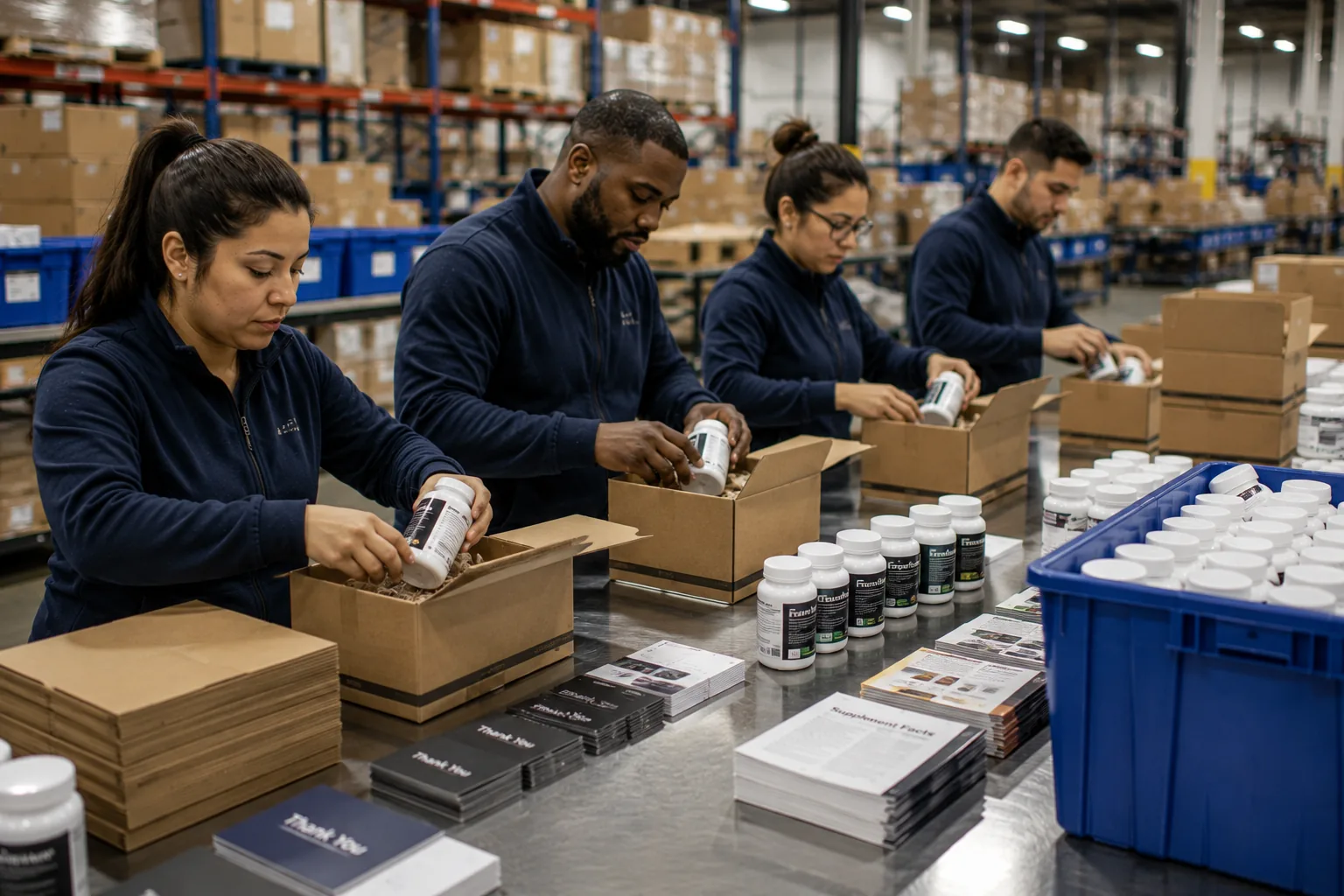
What the handoff actually costs
The gap between a printer and a fulfillment provider is not just freight. It is four separate costs, and only the first is on an invoice.
The freight leg. Palletized printed material is heavy and bulky, so moving it is not trivial, and it takes time that sits between production and availability.
A second receiving event. Everything arriving at a warehouse gets received, counted, and put away. When the printer and warehouse are the same operation, product goes from the bindery to a storage location without an inbound appointment, a bill of lading, or a receiving queue.
Damage exposure in transit. Printed material is more vulnerable than people expect. Cartons get crushed, edges get scuffed, coil bindings distort under compression. Every handling event is an opportunity, and a freight leg is several.
Reconciliation between two vendors. This is the one that costs the most attention. The printer says they shipped 5,000; the warehouse received 4,950. Now somebody has to work out whether 50 were short-shipped, damaged, miscounted at one end, or miscounted at the other, with two sets of paperwork from two companies who each believe their own numbers. Our note on inventory accuracy covers why a variance without contemporaneous evidence is an argument rather than arithmetic.
The consolidated version: the piece comes off the bindery and goes into a storage location in the same system that will later pick it. One count, one record, one company accountable. There is no inter-vendor variance because there is no second party to disagree with.
Where it pays most
Printed product sold direct to consumers
Books, workbooks, journals, planners, card decks. If the printed thing is the product, printing and shipping it from one building removes the entire middle of the supply chain. You are not shipping inventory to a warehouse; you are producing into one.
The same applies to a book that ships as part of a kit, which is a common pattern for course materials and subscription boxes.
Print that gets drawn down over time
Manuals, sales collateral, forms, retail signage, and training material are typically printed in a run and consumed over months. That is a warehousing problem attached to a printing problem, and splitting it across two vendors means paying for a freight leg to move product you are then going to store anyway.
This also changes the quantity calculation from our note on print quantity as an inventory decision. When the storage arrangement is explicit and priced rather than improvised, the trade between unit price and holding cost becomes a decision you can actually model.
Kitting that includes printed components
Kits combining printed material with other product: a welcome kit with a booklet and samples, a course kit with a workbook and materials, a retail display with signage and product. When the printed component is produced in the same building where the kit is assembled, the component never has to be received, stored as a separate inbound, and reconciled.
Inserts and packaging that ship inside other orders
Packing slips, thank-you cards, instruction sheets, promotional inserts, and printed cartons. These are consumed by the fulfillment operation itself, so producing them where they are used is the most direct version of the whole argument. Our note on print inside the parcel covers where those earn their cost.
Where it does not matter much
Being straight about this is more useful than a blanket claim.
One-time bulk delivery to a single address. If you are printing 10,000 catalogs and shipping all of them to your own distribution center in one go, you need a printer and a truck. There is no drawdown, no kitting, and no per-order picking, so consolidation buys you a modest amount.
Work needing a capability we do not have in-house. Hardcover book production runs through a third-party print partner rather than on our own floor, and five specialty finishing operations (foil stamping, embossing, spot UV, die-cutting, and PMS ink matching) run through a finishing partner, carry a 1,000-piece minimum, and are quoted by hand. If your job depends on one of those, part of it leaves the building regardless, and the consolidation argument weakens accordingly. Worth knowing early rather than late.
When your existing printer is genuinely excellent and cheap. A good relationship has real value. If your printer serves you well and your fulfillment is separate but working, the consolidation saving may not clear the switching cost. We would rather say that than pretend otherwise.
The operational detail that makes it work
Consolidation is not automatic just because two functions share a building. The thing that makes it real is that the printed piece enters inventory as a proper record rather than as a pallet somebody knows about.
That means the same requirements as any other inventory: a SKU, a barcode, weight, dimensions, and a replacement cost. Barcoding matters especially for printed product, because every pick is scanned. Barcode-verified picking means the scan checks the SKU against the order before it leaves the aisle, and that control only works if the printed piece carries a barcode that resolves to the right record. It is worth deciding at design stage where the barcode goes, since retrofitting one onto a printed piece means a sticker or a reprint.
Replacement cost matters for a different reason. When product is lost, stolen, or damaged in our possession, we reimburse at 100% of replacement cost, domestic, with no per-package cap, through a claims process we run for you. That settles against the value on record, so an empty field means there is no objective number to settle against.
What to ask about a consolidated arrangement
- How does the printed piece enter inventory, and when can I see it? It should appear as a counted record in a portal you can check, not as a pallet somebody mentions.
- Is storage priced separately, and what does it cost at my peak quantity? Get this in writing before the print run, because the run size determines the footprint.
- Which parts of my job leave the building? Ask directly. Hardcover and specialty finishing are the usual answers.
- What happens if the print run is short? With one accountable party this is a correction rather than a dispute, and it is worth confirming that is how it works.
- Can I reorder without re-specifying? Reordering from a previous job rather than rebuilding the spec is what makes smaller, more frequent runs practical.
Why we are built this way
Most printers hand you pallets and wish you luck, and most 3PLs receive pallets and charge you to put them away. Argo does both because a meaningful share of what our partners sell is printed, and the handoff between those two functions was the part that kept going wrong.
It also reflects how we prefer to compete. We do not compete by being the lowest bid; we compete on systems that reduce waste. A freight leg, a duplicate receiving event, and an inter-vendor reconciliation are waste in the most literal sense: real cost that produces nothing your customer receives.
The bottom line
Printing and fulfilling in one building removes a freight leg, a receiving event, a damage exposure, and a reconciliation. That matters most when the printed piece is the product, when it gets drawn down over time, or when it goes into a kit.
It matters least on a single bulk delivery. And it matters partially when your job needs hardcover or specialty finishing, because those leave the building either way.
Related reading
Print quantity is an inventory decision
How storage cost and obsolescence change the quantity that is genuinely cheapest.
Read →Print inside the parcel
Inserts, packing slips, and printed collateral: where they earn their cost.
Read →See what consolidating would save you
Book a call and bring your current print and fulfillment arrangement. We will work out what the freight leg, the duplicate receiving, and the reconciliation are costing you, and tell you honestly if the answer is not enough to bother.
Book a discovery call