
Print quantity is an inventory decision
Printers quote quantity breaks, and the breaks are real: print more, pay less per piece. So the rational move looks like printing as many as you can afford. It usually is not, because the unit price is only one of four costs, and the other three all rise with quantity. Here is how to work out the number that is genuinely cheapest.
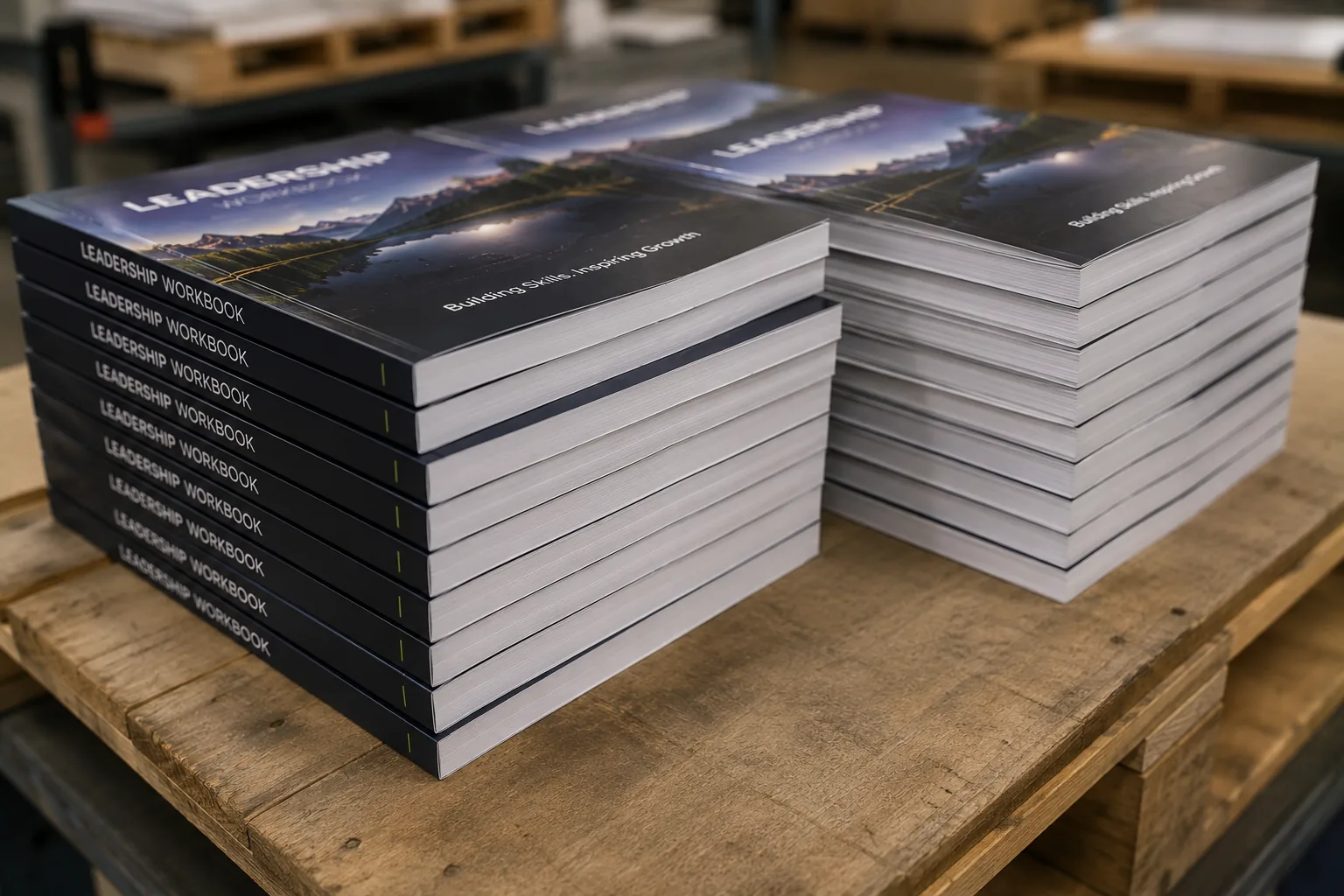
The four costs of a print quantity decision
Unit price is the visible one. The other three are real and mostly invisible at the moment you decide.
Unit cost falls with quantity. Setup dilutes across the run, as our note on how print pricing works explains. This is the force pulling you toward larger runs, and at low quantities it is powerful.
Obsolescence rises with quantity. Every piece has a shelf life set by how fast its content goes stale: a price, a date, a URL, a product line, a person's title, a logo. Print more than you will use before the content changes and the excess is waste, at full cost.
Storage costs rise with quantity. Printed material is bulky. Paper is heavy and takes space, and space costs money whether it is your office, a storage unit, or a warehouse.
Cash timing gets worse with quantity. A larger run means more money spent now for benefit spread over a longer period. For a growing business, cash committed to inventory of any kind is cash unavailable for growth.
The reframe: the cheapest print run is not the one with the lowest unit price. It is the one with the lowest total cost per piece actually used. Those are very different numbers, and the gap is the entire subject of this article.
Cost per piece used, worked through
The arithmetic is straightforward and rarely done. Suppose a piece costs $2.00 each at 500, $1.20 at 1,500, and $0.90 at 5,000. The 5,000 looks decisively cheapest.
Now ask how many you will actually use before the content changes. If the answer is 1,200 over eighteen months, then:
| Quantity | Unit price | Total spend | Pieces used | Cost per piece used |
|---|---|---|---|---|
| 500 | $2.00 | $1,000 | 500, then reprint | $2.00 |
| 1,500 | $1.20 | $1,800 | 1,200 | $1.50 |
| 5,000 | $0.90 | $4,500 | 1,200 | $3.75 |
The 5,000-piece run has the best unit price and by far the worst real cost, because 3,800 pieces went to recycling. The illustration is deliberately clean, and the pattern is not: this is the most common expensive mistake in print buying, and it always feels like prudence at the time.
Note also that the 500 option is not obviously worst. It costs more per piece but leaves you free to change the content, and it does not commit cash or space. Optionality has value that unit price does not capture.
Estimating the shelf life honestly
Everything depends on the "pieces used before it changes" number, so it deserves more than a guess. Four questions that sharpen it:
- What is on this piece that could change? List them: prices, dates, product names, staff names, URLs, addresses, certifications, legal text. The item most likely to change sets the shelf life, not the average.
- How fast did we get through the last run? Actual historical consumption beats projected need, consistently and by a lot.
- What happened to the last run? If you have thrown away the tail of previous print runs, that is your answer about your own forecasting bias.
- Is there a date certain? A rebrand, a price change, a product launch, a regulatory deadline. If one is scheduled, that is a hard ceiling on the quantity worth printing.
The structural fixes
Better than optimizing a single quantity is changing the shape of the problem.
Separate the stable from the volatile
Most pieces mix content that lasts for years with content that changes annually. Splitting them is frequently the highest-return decision available. A durable printed folder with a short-run insert for the parts that change means you print the expensive item once and the volatile item often.
Loose-leaf binder content is the fully developed version of this idea, and it is underused. A manual in a binder lets you reprint nine pages instead of reprinting the book, which turns a reprint into a page swap. If your content has a revision cycle, this is worth serious consideration.
Print in planned waves
Rather than one large run or many panicked small ones, plan a schedule: an initial run sized to real near-term demand and a scheduled reorder. Reorders are cheap to set up because the file is settled and proven, so the second run avoids most of the friction of the first.
This is where a saved, reusable order genuinely helps. When a previous order can be reopened, adjusted, and re-run rather than re-specified from scratch, the administrative cost of ordering less at a time drops substantially, which makes waves practical rather than just theoretically better.
Move the variable content off the press
If the changing element is small, such as a name, a code, a location, or a date, variable data printing can produce different details on each copy within one run. That can eliminate the "print separate versions" problem entirely, and our note on variable data in plain English covers when it pays.
Where storage becomes the deciding factor
Storage is the cost people forget because it arrives monthly rather than at purchase. Two things about it worth planning for.
Printed material is dense and heavy, so it consumes storage capacity quickly. And storage is the cost that keeps accruing on the pieces you are not using, which means an oversized run pays twice: once for the pieces themselves, and then monthly for the space the excess occupies.
The relevant question when you print more than you will immediately use is where it goes and what that costs. If it is going into a warehouse and being drawn down over time, that arrangement should be explicit, priced, and part of the decision rather than an afterthought. Our note on print and fulfillment together covers how that works when both happen in the same building.
The bottom line
Quantity breaks are real and so is obsolescence. The number to optimize is cost per piece actually used, which requires an honest estimate of shelf life rather than a hopeful one.
Before you accept the next quantity break, do two things: work out what you actually consumed from the last run, and list what on the piece could change within a year. If the volatile content changes sooner than you will use the run, the quantity break is not a saving.
Related reading
How print pricing actually works
Why unit cost falls so sharply at low quantities, and where the curve flattens.
Read →Print and fulfillment under one roof
What changes when the printed piece never has to be freighted anywhere.
Read →Work out the right quantity with us
Tell us what the piece is, what could change on it, and how fast you got through the last run. We will quote a few quantities and tell you honestly where the break stops being worth it. If a smaller run plus a scheduled reorder is cheaper for you, we will say so.
Get a print quote