
Expanding into the US: what international brands need from a 3PL
In recent months we've onboarded several brands based in Europe and one from Australia, each bringing its product to American customers through an Argo warehouse. Their questions were remarkably consistent. Here are the answers, and what to look for in a US fulfillment partner when you run the business from another continent.
Why hold inventory in the US at all
The alternative is shipping each order across an ocean, and for most consumer brands that model has gotten harder. Every parcel is its own customs event. Transit is long and variable. Returns are painful enough that many brands quietly write them off. And since the US suspended duty-free de minimis treatment for low-value parcels, the per-order arithmetic has changed for anyone selling into America from abroad. We walked through the numbers in cross-border after de minimis.
Holding inventory in a US warehouse turns that around. You bring product in as one bulk shipment, and from then on each order is an ordinary domestic parcel: domestic transit times, domestic carrier rates, and a domestic returns address. Your American customers get the same experience they'd get from a brand down the road.
Getting your product here
Importing is its own discipline, and it's worth being clear about who does what. Customs entry, duties, the importer of record, and product compliance belong with a licensed customs broker and your freight forwarder. If you don't have them yet, line them up early. They're the people who will tell you what your product needs to clear.
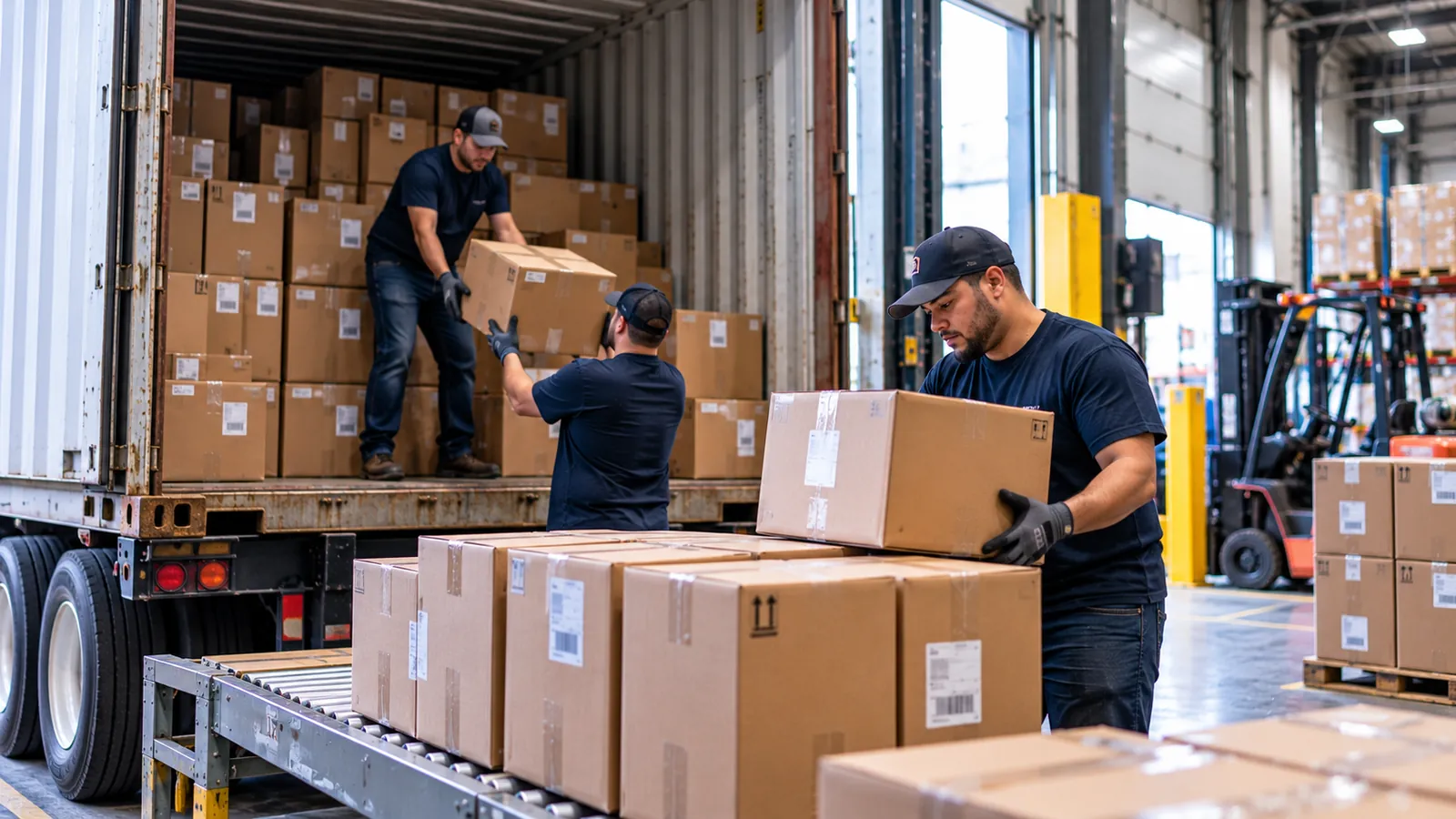
Where we come in is everything after the freight is moving. We arrange inbound shipments from your manufacturers straight to our warehouses, and we receive them at our dock with the same process every partner gets. A few things make that first receipt go smoothly:
- A packing list before the container arrives, by carton and SKU, so we're receiving against an expected list instead of counting blind.
- Labeled cartons, with SKU and quantity on the outside.
- A scannable barcode on every unit. If your products already carry EAN or other retail barcodes, we can usually work with them. Where labels are missing or unscannable, we replace them to your instructions.
- Weights and dimensions for every SKU, before anything ships. An item without a weight can't be rated, so we require one before product is received into stock.
Container unloading and specialized handling are available per the terms in your Order Table. Inbound inventory is typically received within two business days, and we validate inventory accuracy on receipt and report any discrepancies to you.
One tip from recent onboardings: convert your product data before it's urgent. US carriers rate in pounds and inches, and catching a metric-to-imperial mismatch in your SKU file during onboarding is far cheaper than catching it on a carrier adjustment.
Choosing where in the US
The United States is big enough that the choice of warehouse location changes what every order costs. Carriers price by zone, measured from the building an order ships out of, and the same parcel can rate a zone 2 or a zone 8 depending on where it starts.
With multiple warehouse locations, we can design a fulfillment approach that fits where your orders actually go. If you're already selling into the US, your current shipment data will show where your customers cluster. If you're starting fresh, your marketing plan is the best guide to where demand will land first. Either way, the shipping zone map shows how the picture changes from each of our locations.
Connecting your store
Most international brands entering the US already run on a platform like Shopify, often with a separate storefront or market for American customers. Orders flow from your store to our warehouse floor, inventory syncs back, and tracking reaches your customer as soon as a label prints. If your cart, subscription app, or ERP speaks an API, our engineers can wire it in. The integrations page lists what we connect to today.
Shipping inside the US
The US parcel market runs mainly on USPS, UPS, and FedEx, and their pricing differs more than most newcomers expect. Dimensional weight matters, residential delivery often costs extra, and the cheapest carrier changes with weight and destination. You set the delivery options your customers see. Our rate shopping picks the carrier and service for each package, weighing cost, transit time, and reliability. If you're new to the US market, rate shopping is a policy, not a feature is a good primer on how those choices get made.
Running it from another continent
The biggest worry we hear from international partners isn't freight or carriers. It's distance. How do you manage a warehouse you can't drop into, in a time zone where your working day ends as ours begins?
The answer is visibility. Your Partner Portal shows your orders, inventory, shipments, and charges, so you can check the state of your US business at the start of your own day without waiting for anyone. Questions that need a person go to your team at Argo. You'll have a dedicated Partner Success Rep who knows your account, your product, and your quirks.
Onboarding runs on a written plan, too. An Implementation Manager owns your onboarding, and your Partner Success Rep shadows it before taking over the relationship. It's a written handoff of open items and promises made, not an email introduction. For a team on the other side of the world, having the plan and the promises in writing matters even more. Our guide to what a 3PL transition actually looks like covers how those plans are built.
Returns, handled domestically
A US returns address is one of the quiet advantages of US inventory. Returned items are inspected, graded, restocked, repackaged, or disposed of to your specifications, and returns reporting keeps you informed. A customer in Ohio sends their return to a US warehouse, not across the Atlantic or the Pacific.
Why international brands choose a partner like us
The brands that have come to us from Europe and Australia share a pattern. They're established at home, growing, and want a US partner that will treat their business as a priority rather than an export add-on. That's the kind of brand we built Argo for: small enough to respond to unique needs, large enough to get it done.
Our mission is to change our partners' lives by owning everything after the order. For a brand entering a new country, that's a bigger promise than usual, because “everything after the order” includes a market you're still learning. We take that seriously, and we're glad to be the US home for more brands from abroad.
The bottom line
For most international consumer brands, the fastest route to American customers is US inventory with a US fulfillment partner. Bring a customs broker for the import, choose a location that fits where your customers are, connect your store, and insist on a partner who gives you visibility from wherever you happen to be.
Planning your US launch?
Book a 30-minute call with our team. Tell us what you sell, where you sell it today, and where you expect your American customers to be, and we'll walk you through how your product would reach them from our warehouses.
Book your discovery call