
Choosing a binding method
Binding is the decision people make last and regret first. It determines whether your book lies flat on a desk, whether it survives a year in a bag, whether the spine can carry a title, and a meaningful share of what the job costs. Six methods, what each is genuinely for, and the page counts where each stops working.
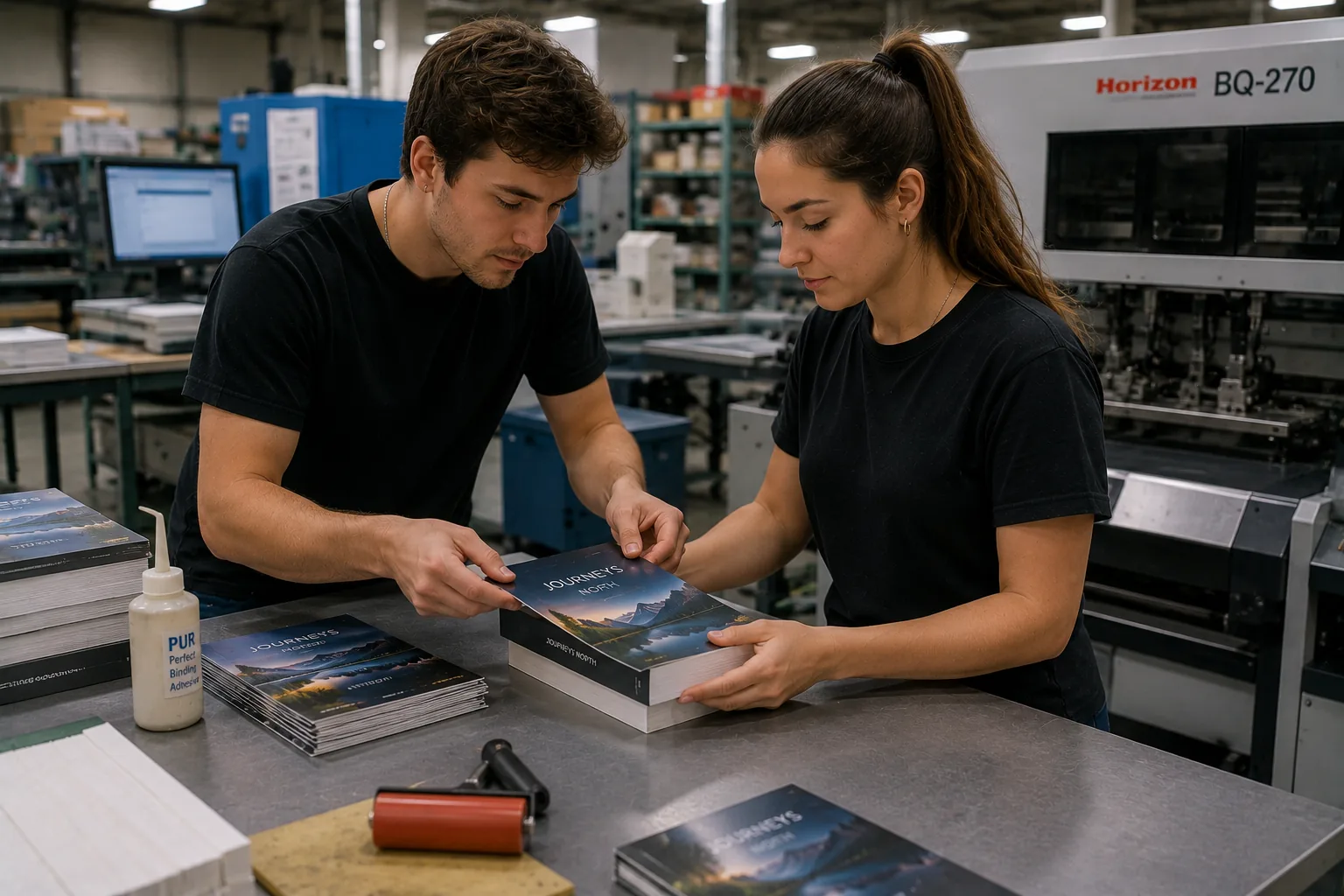
Start with how the piece gets used
Binding questions get answered badly when they start from aesthetics and well when they start from use. Four questions settle most decisions:
- Does it need to lie flat? A workbook someone writes in, a manual propped open next to equipment, a cookbook on a counter. This one constraint eliminates several methods immediately.
- How many pages? Every method has a range where it works and edges where it fails.
- Does content change? If pages get replaced or added, that is a different product category entirely.
- How long does it need to survive? A conference handout and a reference book that lives on a shelf for a decade are different engineering problems.
The six methods
Saddle stitch
Folded sheets nested and stapled through the spine fold. The most economical method for thin books, and the one most magazines and short booklets use.
Best for: booklets, programs, thin catalogs, newsletters, short magazines. Page count: must be a multiple of four, since each sheet makes four pages. Works from about 8 pages up to roughly 64 depending on stock thickness. Lies flat: reasonably, yes. Watch for: no printable spine, and on thicker books the inner pages creep outward and get trimmed narrower than the outer ones, which matters if you have content near the edge.
Saddle stitch also offers a self-cover option, meaning the cover is the same stock as the interior. That removes a separate cover setup and is genuinely cheaper. It looks lighter, which is either fine or not depending on the piece.
Perfect bound
Pages gathered, the spine edge ground and glued, and a wrapped cover applied. This is the paperback book.
Best for: books, thick catalogs, annual reports, anything that wants a printable spine and a bookstore look. Page count: needs enough bulk for a spine, practically around 40 pages minimum, and scales to several hundred. Lies flat: no, and this is the main trade-off. Watch for: the gutter. Content too close to the inside edge disappears into the spine, so keep an adequate inner margin.
Coil bound (spiral)
A plastic coil threaded through punched holes. The workhorse of anything functional.
Best for: workbooks, manuals, cookbooks, planners, anything written in or laid open. Page count: very flexible; coil diameter scales with thickness. We stock diameters from 6 mm, taking about 45 pages, up to 30 mm, taking around 265. Lies flat: completely, and folds back on itself, which is its whole appeal. Watch for: no printable spine, and coils can distort under compression in shipping if not packed thoughtfully.
Wire-O (twin loop wire)
Mechanically similar to coil but using a double-loop wire. It looks more finished and costs a little more.
Best for: presentation documents, premium manuals, calendars, anything where coil's look is too casual. Page count: similar flexibility to coil. Lies flat: yes, and folds back cleanly. Watch for: slightly less forgiving than coil if the piece gets rough handling.
Loose-leaf for binders
Not really binding: printed, drilled sheets the user puts in their own binder.
Best for: training material, price lists, policy manuals, anything where sections get replaced rather than reprinted. Page count: unlimited. Lies flat: yes. Watch for: this is the right answer far more often than people choose it. If your content has a revision cycle, printing 200 bound books and reprinting all of them to fix nine pages is an expensive habit. Loose-leaf turns a reprint into a page swap.
Case bound (hardcover)
Signatures sewn or glued, endsheets attached, and a rigid case built from boards and covering material.
Best for: reference works, gift and premium editions, anything meant to last or to feel substantial. Page count: wide range, but it needs enough bulk to justify a case. Lies flat: partially; sewn bindings do better. Watch for two things. It is the most expensive method by a wide margin, and we produce hardcover through a third-party print partner rather than on our own floor, which means it cannot be instantly priced and a person will quote it. That is worth knowing early if hardcover is in your plan, because it changes both the timeline and the conversation.
Side by side
| Method | Practical page range | Lies flat | Printable spine | Relative cost |
|---|---|---|---|---|
| Saddle stitch | 8–64, in multiples of 4 | Mostly | No | Lowest |
| Perfect bound | 40+ | No | Yes | Moderate |
| Coil | Very flexible | Fully | No | Low to moderate |
| Wire-O | Very flexible | Fully | No | Moderate |
| Loose-leaf | Unlimited | Yes | Binder spine | Low |
| Case bound | Substantial | Partially | Yes | Highest |
Three mistakes we see repeatedly
Perfect binding a workbook. It looks more professional on a sample and fails at the job. If somebody has to write in it, it has to lie flat, and perfect binding does not. This is the most common and most annoying binding regret, because it is only discovered after delivery.
Ignoring the gutter. Perfect-bound books lose inside margin to the spine. Design with an adequate inner margin or watch your content vanish into the fold. A proof will show you this, which is one of several reasons to look at a proof carefully.
Bound books for content that changes. If your material has a revision cycle, loose-leaf or a smaller, more frequent print run beats a large bound run you will obsolete. Our note on print quantity as an inventory decision covers the arithmetic.
The cover decision, briefly
Cover stock and coating are separate choices from binding and they interact with it. Heavier cover stock supports a book better; a coating protects it. Gloss lamination is durable and shows fingerprints less than you would think; matte is softer and scuffs more visibly; soft touch feels premium and is the most delicate. On saddle stitch you can also skip a separate cover entirely with self-cover.
What matters is seeing it. Color and finish both behave differently in your hand than on a monitor, and a physical proof is the only way to settle either.
How we settle these questions
Before a job runs, you get a proof. Nothing goes on press until you approve it in writing, and that approved proof is the standard we hold ourselves to. If the finished job does not match it because of a production error on our end, we make it right with a reprint or a refund. If it does match, and the proof itself had something you would rather change, we will help you fix it on the next run. Terms apply.
For binding specifically, ask for a physical sample rather than a digital proof. A digital proof cannot tell you whether a book lies flat, and that is usually the thing you most need to know.
The bottom line
Pick binding from use, not looks. Does it lie flat, how many pages, does the content change, how long must it last. Those four answers eliminate most of the options and usually leave one obvious choice.
And if somebody is going to write in it, do not perfect bind it.
Related reading
How print pricing actually works
Setup, press sheets, and ganging. Why quantity changes your unit price so much.
Read →Print quantity is an inventory decision
The unit price falls with volume. The obsolescence risk rises. How to find the real optimum.
Read →Not sure which binding fits?
Tell us how the piece gets used, how many pages, and how long it needs to last. We will recommend a method and the reasoning, and send a physical sample so you can check it lies flat before you commit to a run.
Get a print quote