
When a printed box is worth it
A branded box is the most visible upgrade available to a direct-to-consumer brand and one of the easiest to over-buy. It arrives at a customer’s door carrying your name, which is worth something real. It also has minimum order quantities, storage requirements, and a per-unit cost that recurs on every order forever. Here is how to work out whether yours is worth it, and the intermediate options most brands skip past.
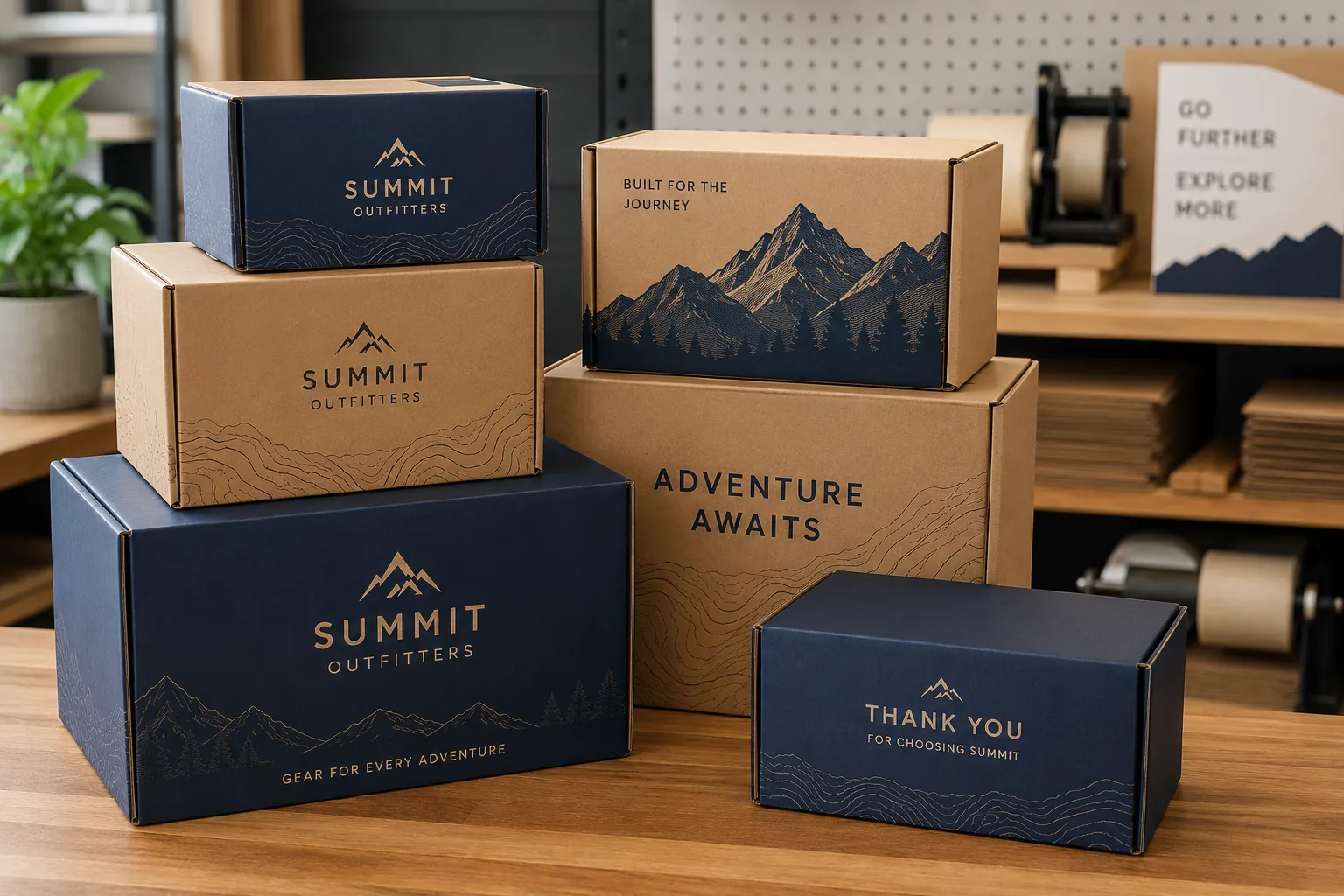
The ladder, from cheapest to most committed
The decision is usually framed as plain box versus printed box. There are at least four rungs between them, and the middle ones capture a surprising share of the benefit at a fraction of the cost and commitment.
| Option | Per-unit cost | Commitment | Impact |
|---|---|---|---|
| Plain corrugated | Lowest | None | None |
| Branded tape on plain box | Very low | Low | Moderate, and visible in transit |
| Printed label on plain box | Low | Low | Moderate, and easy to change |
| Printed inside, plain outside | Moderate | Moderate | High at the unboxing moment |
| Fully printed carton | Highest | High, with minimums | Highest |
Two rungs deserve more attention than they get.
Branded tape is the highest-return packaging spend available to most brands. It is cheap, it works on any box size you already stock, it requires no size-specific commitment, and it is visible during transit rather than only at opening. If you are choosing one intervention, this is usually it.
Printed labels on plain boxes get you brand presence while committing to almost nothing, and crucially they are cheap to change. A brand still refining its identity, or one running seasonal variations, gets flexibility that a printed carton run cannot offer.
The framing that helps: a printed carton is a commitment to a box size, a design, and a quantity, all at once. Tape and labels commit to none of those. If any of the three is still moving, start on a lower rung.
The costs beyond the unit price
Minimum order quantities are real. Custom cartons are produced on tooling and setups that make small runs uneconomic, so a printed box means committing to a quantity that may substantially exceed your near-term need. That is not a printer being difficult; it is the same setup arithmetic that governs all print, described in our note on how print pricing works.
Storage is the cost people forget. Cartons are bulky by definition. A large run of printed boxes occupies real space for months, and it occupies it whether or not you are using them. This is where the quantity decision from print quantity as an inventory decision bites hardest, because the storage footprint of packaging is much worse per dollar than that of flat printed material.
Size lock-in. A printed carton is designed for a specific product configuration. Change the product, add a bundle, or discover that a different size ships cheaper, and your printed inventory fits less well than it did. Brands with evolving product lines get caught here regularly.
Dimensional weight, still. A printed box is subject to exactly the same parcel arithmetic as a plain one. A beautiful carton an inch over a cubic threshold pays an additional handling surcharge on every order, forever. Confirm the dimensional weight and threshold position of a custom carton before committing to a run, not after. Our note on carton economics covers what to check.
When a printed carton genuinely earns it
Four situations where the commitment is usually justified:
- The unboxing is part of the product. Gift items, premium goods, subscription boxes where the reveal is the recurring experience customers pay for.
- Order volume is high and stable in one configuration. High volume amortizes the minimum quickly, and stability means the size will not be obsolete.
- The box is doing structural work. Inserts, dividers, and fitted trays that protect product and present it are engineering as much as branding, and a plain box plus loose void fill is a genuinely worse product.
- Retail-ready presentation. If the pack goes on a shelf, printed packaging is not branding but a requirement.
And two where it usually does not: low or uncertain volume, and a product line still changing shape. In both cases the intermediate rungs deliver most of the effect while keeping your options open.
Getting the print right
Printed packaging has some specific technical considerations worth knowing before you design.
Corrugated is not paper. It has a textured surface and absorbs ink differently, so fine detail, small type, and subtle gradients reproduce less crisply than on coated stock. Designs with bold shapes and clear type work; designs relying on photographic subtlety frequently disappoint.
Large flat areas of solid color are harder than they look. A big field of a single dark color shows imperfection and scuffing readily. It is achievable and it is worth discussing before you commit, especially if it is a brand color you care about.
Precise brand color needs a spot ink. Process printing cannot reproduce every brand color exactly, and on corrugated the gap widens. A PMS ink match is available, and it is one of the five specialty operations that runs through a finishing partner, carries a 1,000-piece minimum, and gets quoted by hand.
See a physical sample. This is not optional for packaging. Color shifts a little between screens, stocks, and presses. That is physics, not a defect. If color has to land exactly, ask for a hard-copy proof and we will match the job to the proof you hold in your hand. Digital proofs are for content, layout, and position; a hard-copy proof is the one that sets the color standard. For a carton you are ordering thousands of, hold one in your hand first.
The interior surface, which is underused
Printing the inside of an otherwise plain box is the most underrated option on the ladder. The outside stays plain corrugated, so it looks unremarkable in transit and attracts no attention in a delivery pile. Then the customer opens it and the interior carries your brand.
It costs less than full printing, it delivers nearly all of the unboxing effect since that is the only moment anyone sees the inside anyway, and it has a practical security benefit: an anonymous exterior advertises less about what is inside.
Deciding it with the parcel in view
The reason we like doing packaging and fulfillment together is that these two decisions get made against each other rather than in sequence. A carton is simultaneously a branding decision and a rate decision, and separating them is how brands end up with a beautiful box that costs an extra surcharge on every order.
Practically, that means checking a candidate carton's dimensional weight and threshold position before the run, sizing the run against real order velocity and available storage, and confirming the design holds up on corrugated with a physical sample. Our box printing and custom packaging pages cover what we produce.
The bottom line
A printed carton is a commitment to a size, a design, and a quantity. If all three are settled and your volume is high, it is frequently worth it. If any is still moving, branded tape, printed labels, or an interior print gets you most of the effect while keeping your options open.
Whatever rung you choose, check the dimensional weight before you order thousands of anything.
Related reading
Your box is a line item and a first impression
Carton rationalization, dimensional thresholds, and where protection and cost balance.
Read →Print inside the parcel
The printed pieces that go inside the box, and which of them earn their cost.
Read →Price the box against the parcel
Tell us your product dimensions and order volume. We will quote printed packaging options across the ladder and check each candidate against the dimensional thresholds, so you can see the shipping consequence before you commit to a run.
Get a print quote