
The short-run shift in commercial print
Commercial printing has been declared dying for twenty years and instead reorganized itself. The market is still enormous, and the structure has changed underneath: away from long offset runs toward shorter digital ones, automated workflows, and personalized output. That shift is mostly good news for brands, and it changes how you should be buying.
What is actually happening
The global commercial printing market was valued at roughly $510 billion in 2025 and continues to grow modestly, at low single-digit rates. That is not an industry disappearing; it is an industry maturing while its internal composition changes.
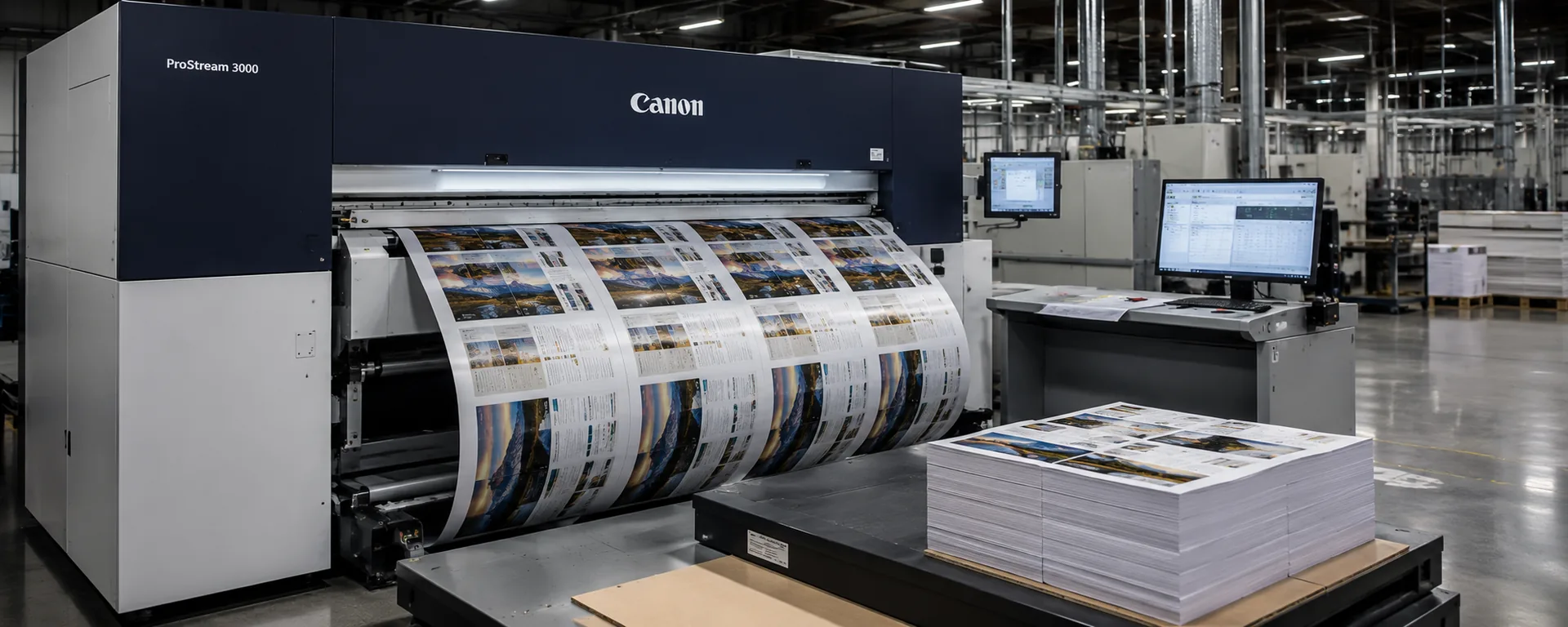
The change has three parts. The industry is shifting toward shorter digital runs, toward automated workflows, and toward more personalized output. Digital inkjet and hybrid systems are displacing legacy equipment even in high-volume environments, because modern digital presses deliver faster turnaround, greater customization, and better cost control than long-run offset for a widening range of work.
Worth being precise about the economics rather than declaring offset obsolete. Offset still wins decisively at high volumes: once you are running many thousands of the same piece, its per-unit cost is hard to beat. Digital wins at low and moderate volumes because it has far less setup to amortize. What has changed is where the crossover point sits, and it has moved steadily toward higher volumes, which means more jobs land on the digital side of the line every year.
Why the crossover point matters to you: it determines your practical minimum order quantity. As the crossover moves up, runs that used to require a large offset commitment become economic digitally, which means you can print fewer, more often, without a punitive unit price.
What it means for how you buy
Smaller runs stopped being a penalty
The old constraint was that short runs carried a brutal unit price, which pushed everyone toward over-printing and created the obsolescence problem described in print quantity as an inventory decision. As short-run economics improve, "print less, more often" becomes viable rather than merely virtuous.
The practical version: run the cost-per-piece-actually-used calculation again if you last did it years ago. The quantity that was optimal under old short-run pricing is probably larger than the one that is optimal now.
Versioning got cheap
Digital production and variable data together make personalized and versioned output practical at volumes where it used to be absurd. Twelve regional variants, or a unique code on every piece, is now a single run rather than twelve jobs or a manual nightmare.
This is the capability most under-exploited by brands, in our experience, mostly because people still price versioning against a mental model from a decade ago.
Turnaround compressed
Less setup means less time to first good copy. That does not make deadlines infinitely flexible, and it does widen what is achievable. Our standard production time is seven days for most work, with expedite available as a line item, and the honest framing is to tell us your deadline and let us tell you whether we can hit it rather than either of us guessing.
Automation moved into estimating
This is the part of the shift least visible to buyers and most consequential for what you pay. When quoting and production planning are automated, two things follow: quotes arrive faster, and the system can find efficiencies a human estimator would not have time to hunt for.
Ganging is the clearest example. If two jobs need the same paper stock, the same printed sides, the same finish, and the same bleed treatment, they can share press sheets and split a setup. Finding those matches manually is impractical, because the opportunity depends on what else happens to be running and it does not last. Our systems identify compatible jobs and group them automatically, and the result appears on your quote as a savings line rather than as an explanation of sheet geometry.
The sustainability angle, honestly
Sustainability is a genuine driver in the industry, with demand for recycled stocks, efficient production, and print-on-demand approaches that reduce waste. It is also an area where claims run ahead of substance across the sector, so it is worth separating what is structural from what is marketing.
The structural point is simple and unglamorous: the most environmentally sound print is print you do not throw away. A run sized to actual consumption wastes less than a larger run at a better unit price with a third of it recycled unread. Ganging reduces waste for the same reason: fewer setups, fewer makeready sheets, less material discarded getting up to color.
Those are not positioning claims. They are the same efficiency arguments that reduce cost, which is why we trust them more than a certification. Reducing waste is how we prefer to compete in the first place: not by being the lowest bid but by running systems that produce less waste, then passing the savings along.
Where this leaves offset and specialty work
Long offset runs are not going away, and neither is specialty finishing. High-volume identical work still belongs on offset. And five finishing operations remain genuinely specialist: foil stamping, embossing, spot UV, die-cutting, and PMS ink matching all run through a finishing partner, carry a 1,000-piece minimum, and are quoted by hand rather than instantly. Hardcover book production similarly runs through a third-party print partner.
None of that contradicts the short-run shift. It means the industry is bifurcating: a widening middle where digital, automated, short-run production dominates, and a specialist tail where minimums and hand quoting are the honest answer. Knowing which side your job is on is most of what you need to plan around.
What to do about it
- Re-run your quantity math. If your standard order quantity was set years ago, short-run economics have probably moved in your favour.
- Separate stable content from volatile content. Print the durable pieces deep and the changing pieces shallow and often. This is where short-run economics pay most.
- Consider versioning you previously dismissed. Regional, segmented, and personalized output is far cheaper than the mental model most buyers still carry.
- Be flexible on stock where you genuinely do not care. It widens the set of jobs yours can be ganged with, which is a direct saving.
- Ask where your job sits relative to the crossover. A printer who can tell you whether your volume favours digital or offset is telling you something useful about your own economics.
The bottom line
Commercial print did not decline; it reorganized around shorter runs, automated workflows, and personalization. For brands, that means lower practical minimums, cheaper versioning, faster turnaround, and less reason to over-print.
The main thing to update is your own assumptions. Most brands are still buying print against economics that stopped being true several years ago.
Related reading
How print pricing actually works
Setup dilution, press sheet geometry, and how ganging lowers the price of every job in a group.
Read →How to buy print without getting burned
The specification that makes quotes comparable, and the five questions to ask about any of them.
Read →Find out where your volume sits
Tell us what you print and how often. We will tell you whether your quantities still make sense under current short-run economics, and where versioning or a smaller, more frequent run would cost you less across the year.
Get a print quote